Local visibility audits for Suffolk County home-service companies
Make sure the company customers find online matches the company you actually run.
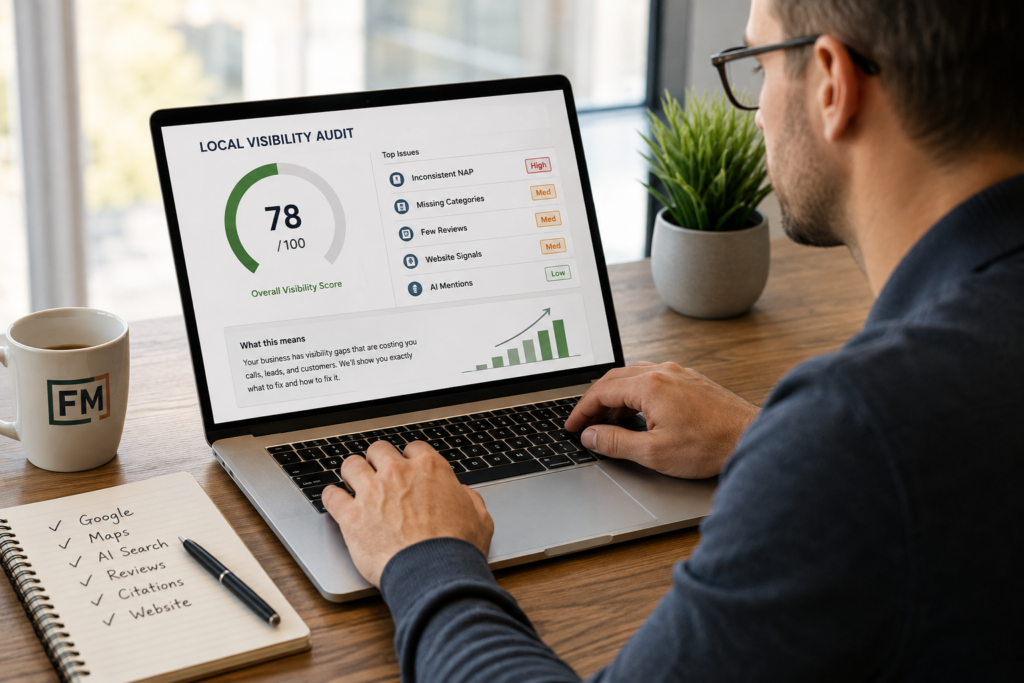
Fieldmark Local compares your real business with what customers see across Google, Maps, your website, major listings, reviews, and selected AI-search experiences. You get documented evidence, a clear view of what you control, and a correction plan ranked by business impact.
Your business can have more than one public version.
Customers may encounter different versions of the same company across Google Search, Google Maps, the business website, Apple Maps, Bing, Yelp, other important third-party sources, and selected AI-search experiences.
Fieldmark Local compares those public representations against the business the owner actually operates, documents material mismatches, and separates what can be corrected directly from what is outdated, conflicting, unmanaged, externally controlled, or dependent on a platform.
Sample demonstration — how one real business can appear differently across key public surfaces.
REAL BUSINESS
- Approved business facts
- Actual service area
- Current hours and phones
- Real services and locations
Google — Correct or Outdated
Business details may be accurate, old, or incomplete.
Maps — Correct or Conflicting
Hours, categories, or service areas may not match the real operation.
Website — Correct or Unmanaged
The site may still show old towns, old services, or the wrong customer path.
Important Third-Party Sources — Outdated or Externally controlled
Apple Maps, Bing, Yelp, and other sources may repeat older or unmanaged information.
AI Search — Selected observations only
AI answers may summarize public sources that are accurate, outdated, conflicting, or outside the owner’s control.
Sample only. This shows the comparison method and does not represent a client engagement or result.
Audit focus
What the audit checks
Business facts and eligibility
Compare the real operating model with public names, addresses, service areas, phones, hours, locations, services, and ownership.
Google and Maps
Review Google Business Profile eligibility and accuracy, categories, services, address or service-area setup, website destination, map representation, photos, ownership, and duplicate risk.
Website and customer path
Review whether the site accurately explains important services, locations, coverage, proof, contact information, forms, phone paths, and calls to action.
Important third-party surfaces
Compare selected customer-facing platforms such as Apple Maps, Bing, Yelp, industry sources, and other sources relevant to that company.
Reviews and visual proof
Review how reviews are requested and handled, privacy or policy concerns, and whether current imagery helps customers verify the real company and its operations.
Search and AI observations
Test a defined set of branded, service, and local questions in selected search and AI systems. Record what appears, what information or sources are visible, and the limits of the observation.
See what an audit finding looks like
The audit goes beyond a checklist of marketing recommendations. Material findings are documented with evidence, customer impact, control, priority, and a recommended next action.
Sample audit finding for demonstration purposes. Not a client case study.
Sample finding
What we found: Google shows the business closing at 5:00 PM while the company’s approved operating information shows 7:00 PM.
Evidence: Google Business Profile captured on the audit date and compared with the approved business information.
Why it matters: A customer searching after 5:00 PM could reasonably assume the company is closed.
Who controls it: Business-controlled, subject to owner verification and Google Business Profile access.
Priority: High
Recommended action: Confirm the operating hours with the owner and correct the Google Business Profile if the discrepancy is verified.
Audit first. Fix what matters. Maintain it only when needed.
Audit
Document the important problems, evidence, and priorities before deciding what work is needed.
Implementation Sprint
Complete approved high-priority corrections identified through the audit.
Governance
Monitor and maintain important information only when recurring work is actually justified.
Pest control focus
Built around how pest control companies actually operate.
Pest control is our deepest specialization
Fieldmark Local serves qualified home-service businesses, but pest control is where our operating experience runs deepest. Founder Andy Carr operated a pest-control company for nine years, giving the audit firsthand context around service areas, routes, recurring work, seasonal services, field operations, customer expectations, and the difference between what a service company actually does and what customers find online.
Andy Carr operated a pest control company for nine years. Fieldmark Local applies that experience to actual service areas, residential versus commercial work, recurring and seasonal services, old business locations, acquisitions or rebrands, phones and quote paths, technicians and vehicles, legitimate business locations, customer expectations, and whether online claims match what the company can really provide.
The recommendations must match what the company can actually deliver, not simply what somebody wants it to rank for.
Not in pest control? See how the audit applies to home-service companies.

What you receive
Executive findings
The most important problems, risks, and opportunities explained in plain language.
Verified business record
The approved business information that important customer-facing sources should match.
Evidence of what customers see
Dated findings from Google, Maps, the website, major third-party platforms, and selected AI-search observations.
Prioritized correction plan
What is wrong, why it matters, who controls it, what it depends on, and what should happen first.
30/60/90-day action plan
A practical sequence for addressing high-priority work without wasting time on low-value changes.
60-minute findings meeting
Walk through the evidence, answer questions, and determine the appropriate next step.
Process
How it works
01 — Audit Fit Check
Confirm how the business operates, the concern being investigated, required access, and whether the audit is appropriate.
02 — Evidence Capture
Compare the actual business with what customers can find across the priority surfaces included in the audit.
03 — Findings & Priorities
Document the meaningful issues, customer consequences, control, dependencies, and correction order.
04 — Choose What Happens Next
Use Fieldmark Local for an Implementation Sprint, use the findings with an existing provider or staff, establish governance when justified, or take no action on low-value issues.
Clear scope. Evidence-backed work. No ranking promises.
Fieldmark Local does not guarantee rankings, map positions, AI citations, leads, revenue, indexing, profile approval, or a specific time to result. We document what customers are seeing, identify what can reasonably be corrected, complete approved work within scope, and measure what can reasonably be measured.