
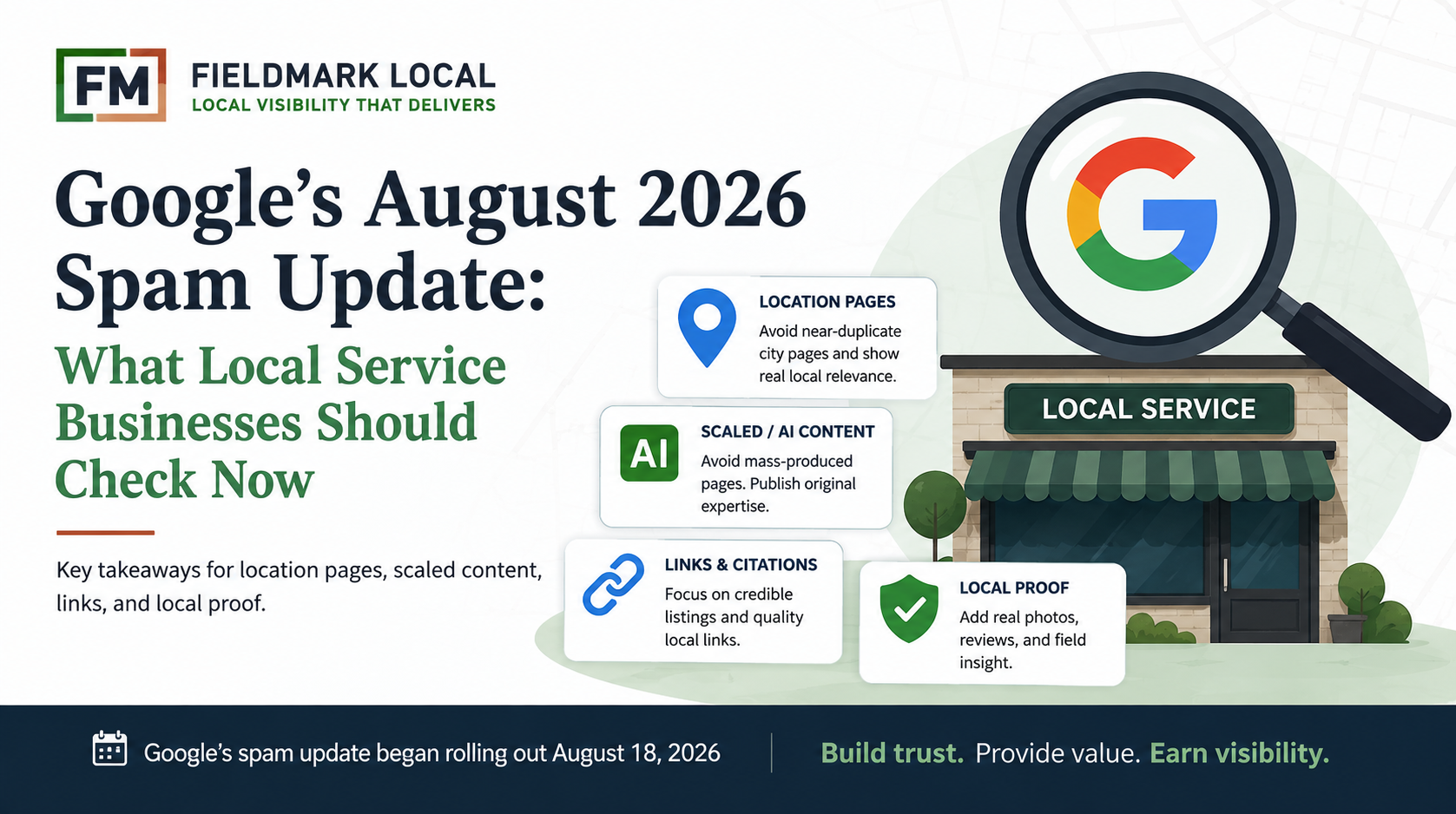
Google began rolling out its August 2026 spam update on August 18, 2026. According to the Google Search Status Dashboard, the update applies globally, across all languages, and may take several days to complete.
Google has not announced that this update specifically targets local SEO, location pages, AI-generated content, backlinks, or any particular industry.
That distinction matters.
There is no reason for a local business to start deleting pages or rewriting its website simply because rankings move during the rollout.
There is, however, a good reason to review whether your local-search strategy relies on practices Google already identifies as spam.
For pest control companies and other service-area businesses, several of those policies deserve attention.
Take a Hard Look at City and Service-Area Pages
Location pages are not inherently a problem.
A pest control company may have legitimate reasons to maintain separate pages for Huntington, Smithtown, Islip, Brookhaven, Southampton, or other communities it serves.
The risk starts when those pages exist primarily to capture different city searches while providing essentially the same information.
Google defines doorway abuse as creating pages intended to rank for similar searches that act as intermediate pages rather than genuinely useful destinations. Google’s examples specifically include multiple pages targeting different cities or regions that ultimately funnel visitors toward the same place.
A common local SEO footprint looks like this:
- Termite Control in Town A
- Termite Control in Town B
- Termite Control in Town C
- Termite Control in Town D
If the only meaningful difference is the town name, that deserves review.
A useful local page should answer a question the broader service page cannot answer as well.
For a pest control company, that might include:
- Services actually offered in that area
- Common pest problems affecting the market
- Inspection or treatment procedures
- Real jobs completed nearby
- Technician or branch information
- Local customer reviews
- Original project photos
- Service boundaries
- Seasonal conditions
- Relevant licensing, certifications or guarantees
The goal is not simply to make each page contain different words.
It is to give the page a legitimate reason to exist.
Watch for Scaled Content Created Mainly to Rank
AI did not suddenly become prohibited because Google launched a spam update.
Google’s position is more specific.
Google says using generative AI or other automation to create many pages without adding value for users can violate its scaled content abuse policy.
That creates a real issue for local businesses adopting AI as a shortcut for SEO.
Generating 100 variations of “Pest Control in [CITY]” and changing a few paragraphs, pest names and geographic references does not automatically create 100 useful local resources.
The same risk applies to large batches of generic articles such as:
- 10 Signs You Have Termites
- How to Prevent Ants
- How to Get Rid of Mosquitoes
- Signs of a Rodent Problem
- When to Call an Exterminator
These topics can be useful. The question is what the business contributes that wasn’t already available across hundreds of other websites.
Original technician knowledge, photographs, treatment procedures, inspection data, videos, customer questions and real field experience can turn commodity content into something worth publishing.
AI can help organize that information.
It should not be the source of the business’s expertise.
Stop Treating Lists of Towns as Local Optimization
Google’s spam policies also identify blocks of cities and regions used in an attempt to manipulate rankings as an example of keyword stuffing.
That matters for service-area businesses.
A footer containing dozens of communities is not automatically a violation, particularly when it serves a legitimate navigation or service-area purpose.
But adding long strings such as “pest control Huntington, pest control Smithtown, pest control Commack, pest control Hauppauge” is not a serious local-search strategy.
Build a clear site architecture instead.
Customers and search engines should be able to understand:
Who you are → what you do → where you do it → why someone should trust you.
Review the Backlink Strategy Too
Location pages aren’t the only concern.
Google’s current spam policies also list low-quality directory links, links created primarily to manipulate rankings, and low-value content created mainly to generate links as examples of link spam.
That doesn’t mean local citations are dead.
Accurate business listings on credible platforms still help establish your company’s presence across the web.
But there is a major difference between maintaining legitimate business profiles and buying hundreds of directory submissions simply because they contain a backlink.
For local businesses, prioritize listings and mentions that strengthen the company’s real-world entity:
- Google Business Profile
- Bing Places
- Apple Business Connect
- Major industry directories
- Trade associations
- Chambers of commerce
- Local organizations
- Manufacturer or dealer directories
- Reputable local media
- Relevant community organizations
Think verification, not backlink volume.
The Same Spam Rules Now Matter to Google’s AI Results
Google has clarified that its spam policies also apply to generative AI responses within Google Search. Its spam documentation includes attempts to manipulate generative AI responses as part of Search spam.
So tactics intended to increase visibility in AI Overviews or other generative search experiences do not operate under a separate rulebook.
That reinforces a principle local businesses should already be following:
Build information that Google can verify rather than content designed to make algorithms repeat a claim.
If your website says you’re the best termite company in the county, that’s marketing.
If Google can find consistent business information, real customer reviews, technician credentials, original project photos, service documentation, industry affiliations and credible third-party references, that’s evidence.
That distinction is becoming increasingly important in AI-assisted search.
What Local Businesses Should Do During the Rollout
Don’t make major changes simply because rankings fluctuate during an active update.
Instead, use this as an audit window.
Website
Check for near-duplicate city pages, thin service-area pages, excessive geographic keyword use, large batches of low-value AI content and pages that exist primarily to rank rather than help customers.
Google Business Profile
Do not react by stuffing additional keywords into your business name, services or description.
Keep your profile accurate and strengthen it with legitimate services, current photos, reviews and complete business information.
Structured Data
There is no special schema markup required because of this update.
Structured data should accurately describe information visible on your website. Adding more schema does not compensate for weak content or weak evidence.
Local Proof
Strengthen the information that proves the business actually operates where and how it claims to.
That can include:
- Real job photos
- Technician credentials
- Licenses
- Certifications
- Customer reviews
- Case examples
- Service documentation
- Industry memberships
- Local partnerships
- Manufacturer relationships
- Consistent third-party business profiles
What I’ll Be Watching
The August 2026 spam update is still rolling out, so it is too early to claim which local-search tactics are gaining or losing visibility because of it.
- The useful signals will come after the rollout:
- Are large networks of thin city pages losing visibility?
- Are strong local businesses with fewer, better-supported pages gaining?
- Are particular link patterns being discounted?
Are legitimate service-area sites moving even though they do not show obvious spam patterns?
Those observations will tell us much more than speculation during the first few days.
For now, the takeaway is straightforward:
Don’t panic because Google launched a spam update. Use it as a reason to check whether your local visibility is supported by real information, real expertise and evidence that can be verified.
That’s a stronger foundation for Google Search, Google Maps and the AI-driven search experiences increasingly influencing how customers choose local businesses.