Category: AI Search

  • We Tested Google Ask Maps Across 30 Suffolk County Pest Control Searches. Here’s What Changed

    We Tested Google Ask Maps Across 30 Suffolk County Pest Control Searches. Here’s What Changed

    TL;DR: Fieldmark Local ran 30 Ask Maps searches across Huntington, Patchogue and Riverhead. As prompts became more specific, the recommendation set changed by an average of 63.6%. When we repeated the exact prompts in a second round, the lists matched by only 61.5% on average. In this test, Ask Maps behaved like a dynamic recommendation system, not a fixed local-business list. The results do not establish ranking factors or predict what every user will see.

    Google is turning Maps into a conversational discovery tool. In its August 6 Ask Maps update, Google described new capabilities for ordering food, finding hotels and events, receiving personalized answers and resuming past conversations. The company’s March introduction to Ask Maps described it as a way to ask complex, real-world questions and receive a customized map instead of manually sorting through place listings and reviews.

    That creates a practical measurement problem for local service businesses. A homeowner can start with a broad request for pest control companies, then add a pest type, reputation requirement, service preference or description of what is happening inside the house. Each added detail may change which businesses are presented and how they are described.

    Fieldmark Local built a two-round observational test to measure three things: how much the recommendation set changed as a prompt became more specific, how closely an identical prompt repeated in a second round, and whether the claims used to justify those recommendations were supported by public evidence.

    How did Fieldmark Local test Ask Maps?

    The test covered Huntington, Patchogue and Riverhead in Suffolk County, New York. All 30 searches were performed on September 6, 2026. Round 1 began at 11:00 a.m. ET, and Round 2 began at 6:00 p.m. ET. We ran 15 prompts in Round 1 and repeated the same 15 prompts in Round 2. Each town used five levels of specificity:

    • Level 1: A broad request for pest control companies in the town.
    • Level 2: A request for a company that handles carpenter ants.
    • Level 3: Carpenter-ant service plus strong customer reviews.
    • Level 4: Carpenter-ant service plus customer comments about clear communication and reliable work.
    • Level 5: A natural homeowner scenario involving possible carpenter ants around a window.

    Every run started in a new Ask Maps conversation. We used the same Google account, browser, device and physical location, copied each prompt exactly, and captured the full written response and screenshot before researching any recommended business. Across all 30 runs, Ask Maps returned 144 named recommendations representing 29 unique businesses.

    Set change measured how many unique business names were different between a specific prompt and that town’s broad Level 1 result. Same-prompt similarity measured the businesses shared by both rounds divided by all unique businesses returned across those two runs. These measures compare membership, not the order in which businesses appeared.

    After capture, we reviewed the official websites and supplied Google Maps or Business Profile links for all 29 businesses. The claim review also checked service-area support separately for each town in which a company was recommended, producing 38 business-town checks.

    How much did a more specific question change the recommendations?

    A great deal. Compared with each town’s broad Level 1 result, the recommendation set changed by 64.5% on average in Round 1 and 62.7% in Round 2. The combined average was 63.6%.

    Study measureRound 1Round 2Combined
    Completed runs151530
    Named recommendations7668144
    Average recommendations per run5.14.54.8
    Average set change vs. Level 164.5%62.7%63.6%
    Level 1 businesses still present at Level 543.8%53.8%48.3%
    Level 5 newcomers vs. Level 150.0%56.3%53.3%
    Same-prompt similarity across roundsN/AN/A61.5%

    Source: Fieldmark Local two-round Ask Maps study. Percentages are rounded to one decimal place.
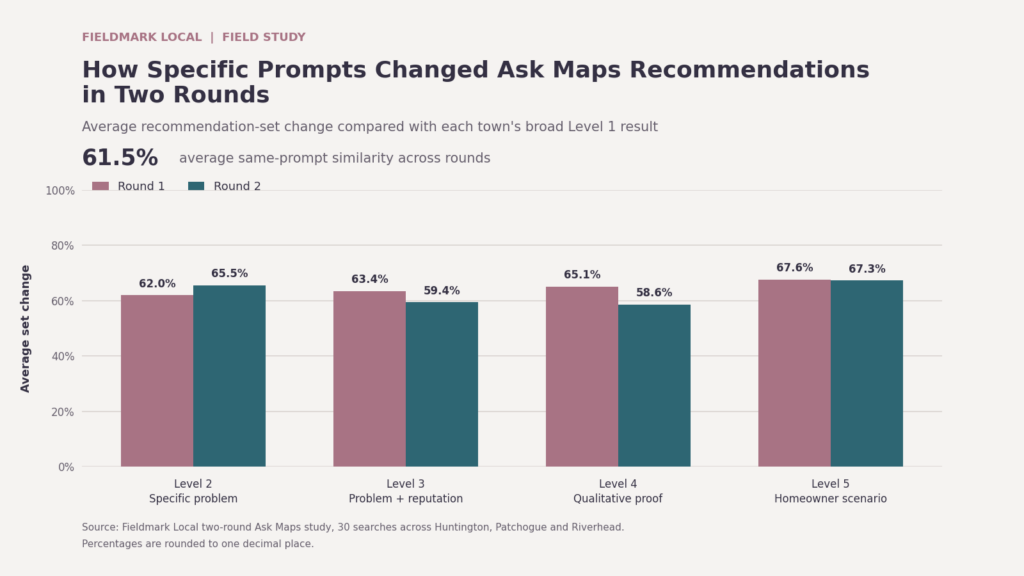
    Bar chart comparing average Ask Maps recommendation-set changes in Round 1 and Round 2 for prompt Levels 2 through 5.

    The effect was strongest in the most natural prompt. At Level 5, the average set change reached 67.6% in Round 1 and 67.3% in Round 2. Across both rounds, only 48.3% of businesses from the broad result remained in the Level 5 result. At the same time, 53.3% of Level 5 recommendations were businesses that had not appeared in that town’s broad list for that round.

    A single broad query therefore provided an incomplete picture of visibility in this test. A business missing from the general list could appear when the request described a specific pest or customer concern. A company visible in the broad list could disappear as those constraints were added. The study does not identify what caused any individual change, but the shift itself repeated in both rounds.

    Did Ask Maps return the same businesses when we repeated a prompt?

    Only partly. Identical prompts produced 61.5% average recommendation-set similarity across the two rounds. Broad Level 1 prompts were the most stable at 74.6%. Level 4 prompts, which added qualitative requirements about communication and reliability, were the least stable at 34.4%. Level 5 homeowner scenarios reached 66.7% similarity.

    The individual lists moved more than the overall candidate pool. Round 2 returned 23 unique businesses, and every one of them had appeared somewhere in Round 1. Six, however, appeared under a different test town. Four businesses were unusually durable and appeared in all ten prompts for their assigned town across both rounds.

    A reasonable interpretation is that Ask Maps assembled changing lists from a substantially overlapping pool of businesses. The test cannot isolate whether a particular change came from personalization, live data, model behavior, location handling or another system input.

    What kinds of claims did Ask Maps use to explain its choices?

    Ask Maps did more than return company names. It supplied detailed explanations about why each business appeared suitable. When we consolidated those statements across the 29 business profiles, the most common claim categories were structural diagnosis or exclusion for 23 businesses, thoroughness or inspection for 18, carpenter-ant expertise for 18, communication or transparency for 16, and response speed for 16.

    Google says Maps can analyze information about hundreds of millions of places, including community reviews, when answering questions. That helps explain why the responses often sounded specific and customer-informed. It does not tell us which source produced a particular sentence or whether any one attribute caused the recommendation. For a broader operational review, use Fieldmark Local’s Google AI visibility checklist.

    How well did the recommendation claims hold up?

    The business-level review produced 17 Verified profiles, seven Weakly Supported profiles and five Mixed profiles. Verified means the material recommendation claims were supported by accessible official website or Google Business Profile evidence. Weakly Supported means the core service or coverage was supported, but specific review-derived language or another detail could not be fully confirmed. Mixed means important claims were supported while another meaningful detail conflicted with, or was not established by, the available evidence.

    The review found practical examples of why verification matters:

    • One business was described as operating 24 hours even though its official site listed service hours of 7 a.m. to 7 p.m.
    • A local operating-history claim could not be confirmed on the company’s official franchise page.
    • One Google Business Profile carried the expected business title, while visible review summaries and owner responses repeatedly named another brand, making review attribution unreliable.
    • Several service-area statements extended beyond the towns clearly supported by the official website.

    None of the 29 profiles was classified as wholly Incorrect or Unverified. That does not mean every sentence in the 144 recommendation occurrences was correct. The classifications summarize the combined claim profile for each unique business, and several profiles contained individual statements that should not be repeated without qualification.

    What should a local service business do with these findings?

    1. Test more than one customer question

    Run a small, repeatable set of prompts that reflects how customers actually describe the job. Include a broad category request, an important service, a reputation requirement and a natural scenario. Repeat the same prompts later. Record the account, device, location, date and exact wording so changes can be interpreted responsibly.

    2. Describe real services in customer language

    A page that says only ‘pest control’ gives customers little help with a carpenter-ant problem around a window. Explain the actual services offered, the situations technicians handle, inspection steps, service limitations and what happens next. Keep the language accurate and readable. Do not add services or towns simply because they appeared in a test prompt.

    3. Reconcile hours, service areas and company history

    Compare the website, Google Business Profile and important third-party listings. Correct conflicting hours, old brand names, unsupported service areas and inconsistent descriptions of ownership or operating history. These issues can confuse customers even when they do not affect whether Ask Maps displays the business.

    4. Build evidence around important claims

    Support meaningful statements with information a customer can verify: service details, licenses or credentials where relevant, clear policies, real job photos, technician explanations and authentic reviews. Ask customers for honest feedback in their own words. Do not script reviews or manufacture examples designed to echo a target prompt.

    5. Treat a visibility test as evidence, not a verdict

    One query can miss a business that appears under a more specific request. One successful result can also disappear in a later run. Track patterns, preserve screenshots and compare the public explanation with the facts the business can document. Avoid major site or profile changes based on a single response.

    What does this study not prove?

    This was a controlled observational test from one account, browser, device and physical location. New conversations were used for every prompt, but account-level history remained available. In one Round 2 response, Ask Maps explicitly indicated that two recommendations had been previously viewed or searched. The rounds should not be described as fully independent.

    The study also involved one partial text capture. Its five-business set was recovered from the first written name and four map pins, but most explanations and the order after the first result were unavailable. A separate response omitted one company name from the narrative, so the business was identified from the matching map pin.

    The results apply to this pest-control test in three Suffolk County towns. They do not establish a universal Ask Maps ranking system, isolate a causal input or predict what another account will receive. Ask Maps is also changing quickly, so this study should be treated as a documented snapshot that can be repeated and compared over time.

    The practical takeaway

    Ask Maps visibility was prompt-sensitive and only moderately repeatable in this study. A business could appear in a broad request and fall out when the homeowner added a specific need. Another business could be absent from the broad list and enter when the question described the actual problem. The accompanying explanations also carried specific claims about expertise, availability, service areas and reputation that did not always match public evidence cleanly.

    Local companies should make their services, coverage and proof easy to verify, then monitor what customers are actually being shown. Fieldmark Local’s Local Visibility Leak Audit compares the business a company operates with what appears across Google, Maps, websites, reviews, listings and selected AI-search experiences. See how the audit applies to pest control companies or request an Audit Fit Check.

    About the author

    Andy Carr is the founder of Fieldmark Local. He has more than 25 years of experience in digital marketing, search, analytics and eCommerce, and previously operated a pest-control company for nine years. That background informed the study’s customer scenarios and its review of service, coverage and reputation claims.
  • How to Show Up in Google AI Results: A Self-Service Checklist for Local Businesses

    How to Show Up in Google AI Results: A Self-Service Checklist for Local Businesses

    Google recently addressed a question more local business owners are asking:

    How do I make sure my business shows up in AI search results?

    The useful part of Google’s answer is that it doesn’t involve a new technical trick, special AI markup or a separate optimization system.

    The fundamentals are much more practical.

    Google says its AI search experiences can use information from websites, Google Business Profiles, photos, videos and other business data when responding to detailed customer questions.

    That means local businesses have an opportunity to improve their AI visibility using assets they already control.

    The challenge is making those assets specific, complete and useful enough to give Google something worth citing or recommending.

    This checklist gives you a practical place to start.

    Replace Generic Advice With First-Hand Expertise

    Google recommends publishing unique, first-hand information instead of producing another version of advice that already exists everywhere online.

    For a local business, that means your strongest content may already be sitting inside the heads of your employees.

    Ask questions such as:

    • What problems do customers misunderstand most often?
    • What does your team notice during inspections, estimates or service calls?
    • What mistakes regularly cost customers money?
    • What conditions are specific to your market?
    • What questions do customers ask before deciding whether to hire you?
    • What situations require a different recommendation than customers usually expect?

    A pest control company, for example, can provide much more useful information from an actual termite inspection than it can from another generic article called “10 Signs You Have Termites.”

    A plumber can explain what actually caused a recurring drain problem.

    A roofer can document why one roof required repair while another needed replacement.

    A landscaper can explain which weed-control approach worked under specific property conditions.

    That is information competitors cannot reproduce simply by asking an AI tool to write about the same topic.

    Self-Service Check

    • Identify five questions customers repeatedly ask.
    • Ask technicians or service staff for real examples.
    • Add original photos where appropriate.
    • Explain what happened, what was found and what was recommended.
    • Remove generic filler that could apply to any company in the country.

    Describe Your Services in Enough Detail for AI to Match You

    Google’s bulletin makes another important point: AI search can break a complicated customer question into more specific subtopics.

    A customer may not simply search for a “landscaper.”

    They may ask about chemical-free weed removal, herbicide treatments or ways to prevent weeds from returning.

    The same principle applies across local services.

    A pest control company shouldn’t stop at:

    Pest Control

    It may need to clearly describe:

    • Termite inspections
    • Termite treatments
    • Carpenter ant control
    • Rodent exclusion
    • Mosquito treatments
    • Tick control
    • Bed bug treatment
    • Commercial pest management
    • Preventive service plans

    Your website and Google Business Profile should accurately describe the services you really provide.

    Don’t add services just because they sound like useful keywords. The goal is to give Google better information about what your company actually does.

    Self-Service Check

    • Review every service listed on your Google Business Profile.
    • Compare those services with the services shown on your website.
    • Add legitimate specialties that are currently missing.
    • Make sure important services have useful supporting website content.
    • Remove outdated or inaccurate offerings.
    • Check whether customers use different terminology for the same service.

    Make Important Information Readable on Your Website

    Google specifically recommends putting important business information into readable website text instead of hiding it inside graphics or images.

    That sounds basic, but local business websites violate this constantly.

    Hours may appear only in an image.

    Service areas may be shown only on a map.

    Important service information may be locked inside a PDF.

    Pricing explanations may exist only in a graphic.

    Photos may contain useful information that is never explained in the page copy.

    Your most important business facts should exist as actual webpage content.

    Self-Service Check

    Make sure Google can easily find:

    • Business name
    • Phone number
    • Hours
    • Services
    • Service areas
    • Locations
    • Important policies
    • Qualifications or certifications
    • Useful service details
    • Links to important pages

    Then check the basics:

    • Website works properly on mobile.
    • Important pages load quickly.
    • Navigation works.
    • Internal links aren’t broken.
    • Important content is not contained only inside images.

    You do not need to make the site complicated.

    You need to make the business easy to understand.

    Complete Your Google Business Profile

    For local businesses, the Google Business Profile remains one of the most important sources of verified business information available to Google.

    Google’s own bulletin recommends keeping local business information complete because generative search experiences can draw from Business Profiles when recommending local companies and services.

    Review more than your business name and phone number.

    Google Business Profile Checklist

    • Correct primary category
    • Appropriate secondary categories
    • Accurate business hours
    • Holiday and special hours
    • Correct phone number
    • Correct website
    • Accurate service areas where applicable
    • Complete services
    • Relevant attributes
    • Current business description
    • Recent photos
    • Useful videos when available
    • Products where relevant
    • Current offers or updates where appropriate

    Accuracy matters more than filling every field simply because the field exists.

    Give Google Visual Evidence

    Google specifically points out that its AI experiences can use more than webpage text.

    Photos and videos can also become part of how a business appears across Google’s search experiences.

    For local companies, visuals serve another purpose as well: they prove the business exists and does the work it claims to perform.

    Useful visual evidence can include:

    • Technicians in the field
    • Completed projects
    • Before-and-after examples
    • Equipment
    • Storefronts
    • Vehicles
    • Team members
    • Inspection findings
    • Products
    • Showrooms
    • Real customer environments where permission allows

    Avoid relying entirely on stock photography.

    A polished stock image might improve page design, but it doesn’t prove that your company repaired the roof, treated the termites or installed the lighting.

    Self-Service Check

    • Add recent original photos to your Google Business Profile.
    • Use original images on important service pages.
    • Give images descriptive filenames where practical.
    • Add accurate alt text when the image contributes meaningful information.
    • Explain significant images in the surrounding webpage copy.
    • Add useful video when it genuinely demonstrates expertise or service.

    Check Whether Your Business Information Agrees Across the Web

    Google’s bulletin focuses heavily on the website and Business Profile, but there is another practical question local businesses should ask:

    Does the rest of the web confirm the same business?

    Customers and search systems may encounter your company on:

    • Apple Maps
    • Bing Places
    • Yelp
    • Industry associations
    • Manufacturer directories
    • Chambers of commerce
    • Local business directories
    • Social profiles
    • Local news sites
    • Trade organizations

    You do not need hundreds of directory listings.

    You do want the important sources to consistently describe the same business.

    Self-Service Check

    • Search your business name.
    • Search your phone number.
    • Search your address.
    • Review major local and industry listings.
    • Correct outdated business information.
    • Remove duplicate profiles where possible.
    • Look for old addresses, phone numbers or website URLs.
    • Identify important industry sources where the business should legitimately appear.

    Think of this as verification, not link building.

    Build a Proof Layer Around Important Claims

    There is a major difference between telling Google something and giving Google evidence.

    “Best pest control company on Long Island” is a marketing claim.

    A page showing years in business, technician credentials, real reviews, service documentation, project photos and credible third-party references provides evidence.

    Whenever your website makes an important claim, ask:

    What supports this?

    Examples include:

    • Licenses
    • Certifications
    • Awards
    • Manufacturer relationships
    • Professional memberships
    • Customer reviews
    • Case examples
    • Original photos
    • Service guarantees
    • Published policies
    • Third-party references

    Your website should not manufacture authority.

    It should document the authority the business actually has.

    Don’t Chase Special “AI SEO” Tricks

    One of the most useful points in Google’s guidance is what it does not recommend.

    Google does not tell small businesses to install special AI schema, create an llms.txt file, rewrite every page for an answer engine or buy an “AI optimization” plugin.

    That doesn’t mean technical SEO is irrelevant.

    Structured data, crawlability, indexing, internal linking and site architecture still matter.

    But Google’s message to small businesses is much simpler:

    Make the business clear.

    Make the services specific.

    Publish useful first-hand information.

    Keep your profile accurate.

    Make important information accessible.

    Provide real evidence.

    Those are durable improvements regardless of whether the customer finds you through traditional Google Search, Maps or an AI-generated result.

    Local AI Visibility Self-Service Checklist

    Before paying someone to improve your AI visibility, see how many of these you can answer yes to.

    Website

    • Every major service is clearly explained.
    • Important services have dedicated supporting content.
    • Business information appears as readable text.
    • Important pages work correctly on mobile.
    • Navigation and internal links work.
    • The site contains original first-hand expertise.
    • Important claims are supported by evidence.

    Google Business Profile

    • Categories are accurate.
    • Services are complete.
    • Hours are current.
    • Website and phone information are correct.
    • Service areas are accurate.
    • Recent original photos have been added.
    • Important attributes are complete.
    • The business description accurately represents the company.

    Local Proof

    • Major third-party listings are accurate.
    • Business information is consistent across important sources.
    • Reviews provide evidence of real customer experience.
    • Licenses and credentials are documented where relevant.
    • Real project or service photos are available.
    • Industry relationships and memberships are documented.

    Content

    • Content answers real customer questions.
    • Articles contain first-hand knowledge.
    • Service terminology matches how customers actually search.
    • Important niche services are explained.
    • Generic AI-generated filler has been removed.

    Where Self-Service Usually Stops

    A motivated business owner can handle a significant portion of this checklist.

    The harder questions come afterward:

    Which services are missing from Google’s understanding of the business?

    Which locations lack enough supporting evidence?

    Which third-party sources contradict the website or Business Profile?

    Which competitors are being cited or recommended instead?

    Which pages are technically accessible but still not being indexed, cited or surfaced?

    That is where an audit becomes useful.

    The purpose isn’t to create another list of SEO tasks.

    It’s to identify the specific gaps preventing search engines, maps and AI systems from confidently understanding and recommending the business.