Google recently addressed a question more local business owners are asking:
How do I make sure my business shows up in AI search results?
The useful part of Google’s answer is that it doesn’t involve a new technical trick, special AI markup or a separate optimization system.
The fundamentals are much more practical.
Google says its AI search experiences can use information from websites, Google Business Profiles, photos, videos and other business data when responding to detailed customer questions.
That means local businesses have an opportunity to improve their AI visibility using assets they already control.
The challenge is making those assets specific, complete and useful enough to give Google something worth citing or recommending.
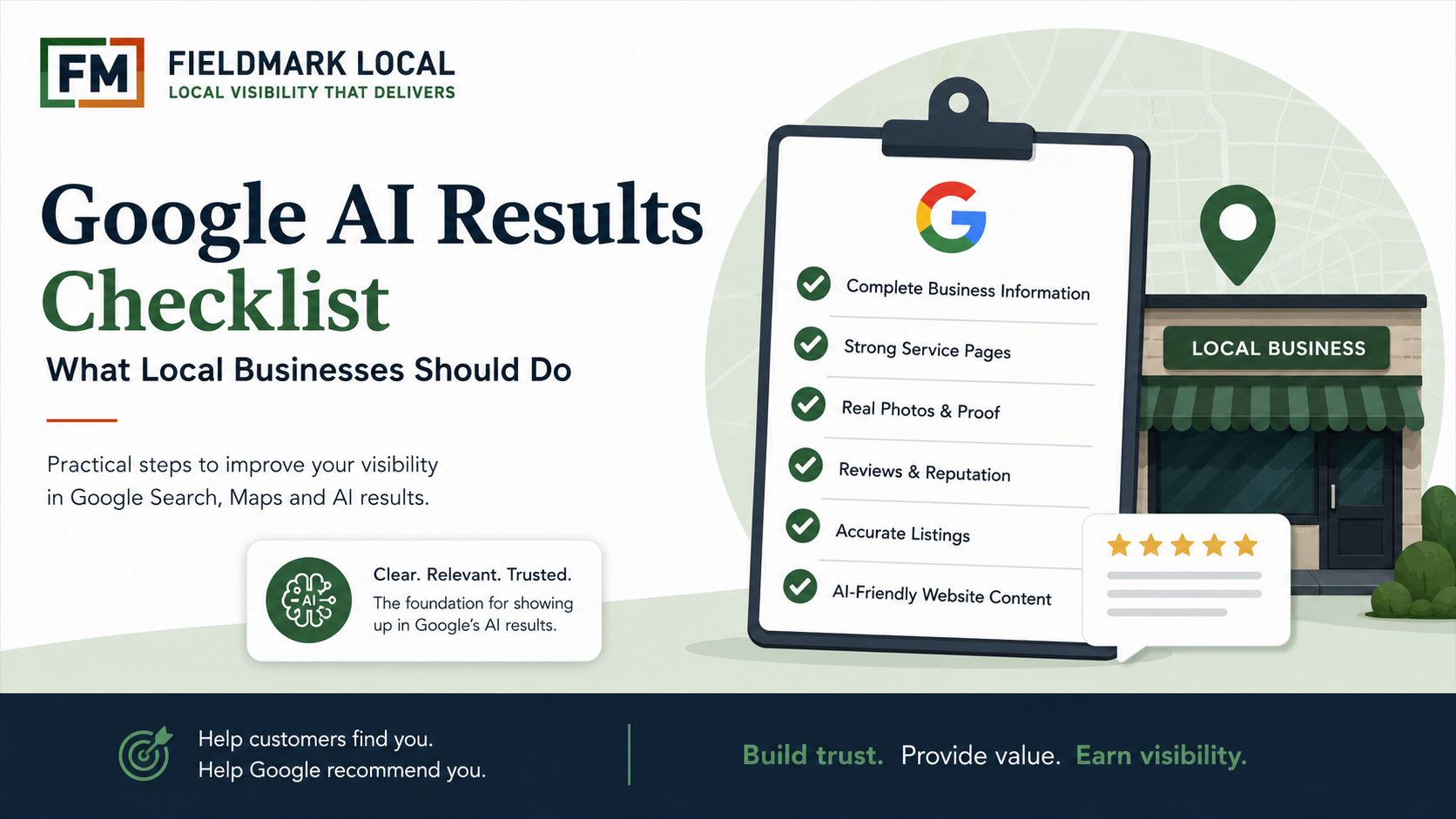
This checklist gives you a practical place to start.
Replace Generic Advice With First-Hand Expertise
Google recommends publishing unique, first-hand information instead of producing another version of advice that already exists everywhere online.
For a local business, that means your strongest content may already be sitting inside the heads of your employees.
Ask questions such as:
- What problems do customers misunderstand most often?
- What does your team notice during inspections, estimates or service calls?
- What mistakes regularly cost customers money?
- What conditions are specific to your market?
- What questions do customers ask before deciding whether to hire you?
- What situations require a different recommendation than customers usually expect?
A pest control company, for example, can provide much more useful information from an actual termite inspection than it can from another generic article called “10 Signs You Have Termites.”
A plumber can explain what actually caused a recurring drain problem.
A roofer can document why one roof required repair while another needed replacement.
A landscaper can explain which weed-control approach worked under specific property conditions.
That is information competitors cannot reproduce simply by asking an AI tool to write about the same topic.
Self-Service Check
- Identify five questions customers repeatedly ask.
- Ask technicians or service staff for real examples.
- Add original photos where appropriate.
- Explain what happened, what was found and what was recommended.
- Remove generic filler that could apply to any company in the country.
Describe Your Services in Enough Detail for AI to Match You
Google’s bulletin makes another important point: AI search can break a complicated customer question into more specific subtopics.
A customer may not simply search for a “landscaper.”
They may ask about chemical-free weed removal, herbicide treatments or ways to prevent weeds from returning.
The same principle applies across local services.
A pest control company shouldn’t stop at:
Pest Control
It may need to clearly describe:
- Termite inspections
- Termite treatments
- Carpenter ant control
- Rodent exclusion
- Mosquito treatments
- Tick control
- Bed bug treatment
- Commercial pest management
- Preventive service plans
Your website and Google Business Profile should accurately describe the services you really provide.
Don’t add services just because they sound like useful keywords. The goal is to give Google better information about what your company actually does.
Self-Service Check
- Review every service listed on your Google Business Profile.
- Compare those services with the services shown on your website.
- Add legitimate specialties that are currently missing.
- Make sure important services have useful supporting website content.
- Remove outdated or inaccurate offerings.
- Check whether customers use different terminology for the same service.
Make Important Information Readable on Your Website
Google specifically recommends putting important business information into readable website text instead of hiding it inside graphics or images.
That sounds basic, but local business websites violate this constantly.
Hours may appear only in an image.
Service areas may be shown only on a map.
Important service information may be locked inside a PDF.
Pricing explanations may exist only in a graphic.
Photos may contain useful information that is never explained in the page copy.
Your most important business facts should exist as actual webpage content.
Self-Service Check
Make sure Google can easily find:
- Business name
- Phone number
- Hours
- Services
- Service areas
- Locations
- Important policies
- Qualifications or certifications
- Useful service details
- Links to important pages
Then check the basics:
- Website works properly on mobile.
- Important pages load quickly.
- Navigation works.
- Internal links aren’t broken.
- Important content is not contained only inside images.
You do not need to make the site complicated.
You need to make the business easy to understand.
Complete Your Google Business Profile
For local businesses, the Google Business Profile remains one of the most important sources of verified business information available to Google.
Google’s own bulletin recommends keeping local business information complete because generative search experiences can draw from Business Profiles when recommending local companies and services.
Review more than your business name and phone number.
Google Business Profile Checklist
- Correct primary category
- Appropriate secondary categories
- Accurate business hours
- Holiday and special hours
- Correct phone number
- Correct website
- Accurate service areas where applicable
- Complete services
- Relevant attributes
- Current business description
- Recent photos
- Useful videos when available
- Products where relevant
- Current offers or updates where appropriate
Accuracy matters more than filling every field simply because the field exists.
Give Google Visual Evidence
Google specifically points out that its AI experiences can use more than webpage text.
Photos and videos can also become part of how a business appears across Google’s search experiences.
For local companies, visuals serve another purpose as well: they prove the business exists and does the work it claims to perform.
Useful visual evidence can include:
- Technicians in the field
- Completed projects
- Before-and-after examples
- Equipment
- Storefronts
- Vehicles
- Team members
- Inspection findings
- Products
- Showrooms
- Real customer environments where permission allows
Avoid relying entirely on stock photography.
A polished stock image might improve page design, but it doesn’t prove that your company repaired the roof, treated the termites or installed the lighting.
Self-Service Check
- Add recent original photos to your Google Business Profile.
- Use original images on important service pages.
- Give images descriptive filenames where practical.
- Add accurate alt text when the image contributes meaningful information.
- Explain significant images in the surrounding webpage copy.
- Add useful video when it genuinely demonstrates expertise or service.
Check Whether Your Business Information Agrees Across the Web
Google’s bulletin focuses heavily on the website and Business Profile, but there is another practical question local businesses should ask:
Does the rest of the web confirm the same business?
Customers and search systems may encounter your company on:
- Apple Maps
- Bing Places
- Yelp
- Industry associations
- Manufacturer directories
- Chambers of commerce
- Local business directories
- Social profiles
- Local news sites
- Trade organizations
You do not need hundreds of directory listings.
You do want the important sources to consistently describe the same business.
Self-Service Check
- Search your business name.
- Search your phone number.
- Search your address.
- Review major local and industry listings.
- Correct outdated business information.
- Remove duplicate profiles where possible.
- Look for old addresses, phone numbers or website URLs.
- Identify important industry sources where the business should legitimately appear.
Think of this as verification, not link building.
Build a Proof Layer Around Important Claims
There is a major difference between telling Google something and giving Google evidence.
“Best pest control company on Long Island” is a marketing claim.
A page showing years in business, technician credentials, real reviews, service documentation, project photos and credible third-party references provides evidence.
Whenever your website makes an important claim, ask:
What supports this?
Examples include:
- Licenses
- Certifications
- Awards
- Manufacturer relationships
- Professional memberships
- Customer reviews
- Case examples
- Original photos
- Service guarantees
- Published policies
- Third-party references
Your website should not manufacture authority.
It should document the authority the business actually has.
Don’t Chase Special “AI SEO” Tricks
One of the most useful points in Google’s guidance is what it does not recommend.
Google does not tell small businesses to install special AI schema, create an llms.txt file, rewrite every page for an answer engine or buy an “AI optimization” plugin.
That doesn’t mean technical SEO is irrelevant.
Structured data, crawlability, indexing, internal linking and site architecture still matter.
But Google’s message to small businesses is much simpler:
Make the business clear.
Make the services specific.
Publish useful first-hand information.
Keep your profile accurate.
Make important information accessible.
Provide real evidence.
Those are durable improvements regardless of whether the customer finds you through traditional Google Search, Maps or an AI-generated result.
Local AI Visibility Self-Service Checklist
Before paying someone to improve your AI visibility, see how many of these you can answer yes to.
Website
- Every major service is clearly explained.
- Important services have dedicated supporting content.
- Business information appears as readable text.
- Important pages work correctly on mobile.
- Navigation and internal links work.
- The site contains original first-hand expertise.
- Important claims are supported by evidence.
Google Business Profile
- Categories are accurate.
- Services are complete.
- Hours are current.
- Website and phone information are correct.
- Service areas are accurate.
- Recent original photos have been added.
- Important attributes are complete.
- The business description accurately represents the company.
Local Proof
- Major third-party listings are accurate.
- Business information is consistent across important sources.
- Reviews provide evidence of real customer experience.
- Licenses and credentials are documented where relevant.
- Real project or service photos are available.
- Industry relationships and memberships are documented.
Content
- Content answers real customer questions.
- Articles contain first-hand knowledge.
- Service terminology matches how customers actually search.
- Important niche services are explained.
- Generic AI-generated filler has been removed.
Where Self-Service Usually Stops
A motivated business owner can handle a significant portion of this checklist.
The harder questions come afterward:
Which services are missing from Google’s understanding of the business?
Which locations lack enough supporting evidence?
Which third-party sources contradict the website or Business Profile?
Which competitors are being cited or recommended instead?
Which pages are technically accessible but still not being indexed, cited or surfaced?
That is where an audit becomes useful.
The purpose isn’t to create another list of SEO tasks.
It’s to identify the specific gaps preventing search engines, maps and AI systems from confidently understanding and recommending the business.